
Running a referral program on Shopify puts your existing customers to work. Instead of relying solely on paid ads and marketing spend, you harness word-of-mouth to bring in new buyers. But a referral program only works if it’s easy to run, fair to track, and rewarding enough that customers actually bother sharing.
Most merchants underestimate how much revenue sits on the table with referrals. A customer who came through a friend’s recommendation tends to stick around longer and spend more. If you’re not capturing that, you’re leaving money on the shelf.
Why Referral Programs Drive Results
Referral programs work because they align incentives. You want more customers. Your existing customers want a reason to evangelize your brand. A well-designed referral program makes both things happen at once.
The mechanics are simple: an existing customer refers a friend, the friend buys, and both parties get rewarded. Simple doesn’t mean it happens by accident, though. You need to make sharing easy, track referrals accurately, and deliver rewards on time, or the whole thing falls apart.
Data backs this up. Referred customers have higher lifetime value, lower churn rates, and spend 25% more on average than cold traffic. Your referral program becomes a revenue multiplier if it’s set up right.
What to Look for in a Shopify Referral Program Tool
Not all referral tools are created equal. Before you pick one, know what actually works.
Easy Setup, No Code Required
You don’t have time to hire a developer to configure a referral program. The tool should work out of the box. You set the incentive structure, choose a reward type, and launch. If you’re waiting weeks for a developer, that’s a tool designed for enterprise, not you.
Accurate Tracking and Attribution
If your referral program loses track of who referred whom, you’ll pay out rewards to the wrong people or miss tracking valid referrals altogether. The system needs to track referrals across devices, remember referrers even when customers don’t click through immediately, and attribute sales correctly.
Bad tracking kills trust fast. Customers who don’t get credit for referrals stop participating. Your program dies.
Flexible Reward Types
Not every customer wants the same thing. Some want store credit, others prefer discounts, some want points they can stack. Your referral tool should let you offer multiple reward types so customers actually claim and use their rewards.
Clean Referral Page and Share Options
Customers need to easily find their referral link, understand what they’re promoting, and share it with minimal friction. A clunky or confusing referral page kills conversions. The page should be on-brand, fast-loading, and let customers copy a link or share directly to email, social, or messaging apps.
Real-Time Analytics
You need to see what’s working. Track referral clicks, conversion rates, reward payouts, and ROI. Without visibility, you’re flying blind and can’t optimize.
How to Design Your Referral Incentive Structure
The offer is everything. Get this wrong, and nobody participates. Get it right, and you’ll see referrals compound.
Match Your AOV and Margins
Your reward structure needs to fit your business. If your average order is $50 and margins are thin, a $20 reward per referral makes sense. If your AOV is $200, you can offer more aggressive incentives.
A good baseline: offer 10-15% of your average order value to the referring customer, and a smaller discount (5-10%) to the new customer. This gives the referrer skin in the game while making the new customer feel like they’re getting a deal.
Tier Your Rewards for Repeat Referrers
Some customers refer once. Others become referral machines if you give them reason to. Build in tiered rewards: first referral gets $10, fifth referral gets $20, tenth gets $30. This keeps top referrers motivated and drives disproportionate results from your best advocates.
Make the Reward Immediate
Don’t make customers wait. If someone earns a reward for a successful referral, credit it within 24 hours. Instant or near-instant rewards increase perceived value and keep momentum.
Decide: One-Way or Two-Way Rewards
One-way rewards go only to the referrer. Two-way rewards incentivize both the referrer and the new customer. Two-way programs typically see higher participation because both parties benefit. If budget allows, go two-way.
Step-by-Step Setup Process
Getting a referral program live doesn’t require technical expertise. Here’s how to do it.
Define Your Incentive Structure
Decide how much you’ll reward per referral, whether it’s one-way or two-way, and what form the reward takes (store credit, discount code, points). Write this down before you touch your tool. This clarity saves setup time.
Set Up the Referral Tool
Install your chosen referral app from the Shopify app store. Configure the reward structure, choose your payout method, and customize the referral page to match your brand. Most tools walk you through this with guided setup flows.
Customize the Referral Page
Your referral page is your sales page for the program. Add a clear headline explaining the benefit, show exactly what the reward is, and include a prominent button to copy or share the referral link. Make it obvious how the program works in under 10 seconds.
Add Referral Links to Key Pages
Put a link to your referral program in your footer, post-purchase email, order confirmation page, and loyalty section (if you have one). The more visible you make it, the more customers will use it.
Launch and Monitor
Go live with your program and watch the first week of data. Check your referral analytics daily. Look for which customers are driving the most referrals, which incentive structure is converting best, and where new customers are coming from. Adjust as needed.
Common Referral Program Mistakes
Knowing what not to do saves you wasted setup and lost revenue.
Setting Rewards Too Low
If the reward isn’t compelling, customers won’t bother. A $2 discount when your AOV is $100 won’t move people. Test on the higher side of what your margins allow. You can always dial it back if payback period suffers.
Making Sharing Difficult
If customers need to write out their referral code manually or jump through hoops to share, they won’t. One-click sharing to email, text, or social is non-negotiable. The easier it is, the higher your participation.
Unclear Terms
If customers don’t know when they’ll get their reward, how to claim it, or what the requirements are, they’ll assume it’s broken and leave. State everything clearly: “Referral must complete a purchase of $X+ to qualify. Reward credited within 24 hours.”
Not Promoting It
A referral program only works if customers know about it. Add it to your post-purchase email, order confirmation, product pages, and email newsletter. Run a campaign when you first launch. If you don’t tell people it exists, they won’t use it.
Ignoring Top Referrers
Some customers generate 50% of your referral volume. Treat them differently. Send them exclusive rewards, feature them in your newsletter, give them early access to new products. Your best referral program participants deserve recognition.
Measuring Referral Program Success
You need to know if your program is actually profitable. Track these metrics from day one.
Referral Conversion Rate
What percentage of referred visitors actually buy? A 2-3% conversion rate is solid. Below 1% means either your offer isn’t compelling or the referred traffic is low-intent.
Cost Per Referral
Divide total rewards paid by total referrals generated. If you’re paying $15 per successful referral and the referred customer spends $60, your payback is 25% of first-purchase value, which is reasonable.
Customer Lifetime Value of Referred Customers
Referred customers stay longer and spend more. Compare the CLV of referred customers to cold traffic. If referred customers are worth 30% more, that validates the program’s strategic value beyond first purchase.
Repeat Referral Rate
What percentage of customers who made one successful referral go on to make another? High repeat rates (30%+) show your program is sticky and becoming part of your customer behavior.
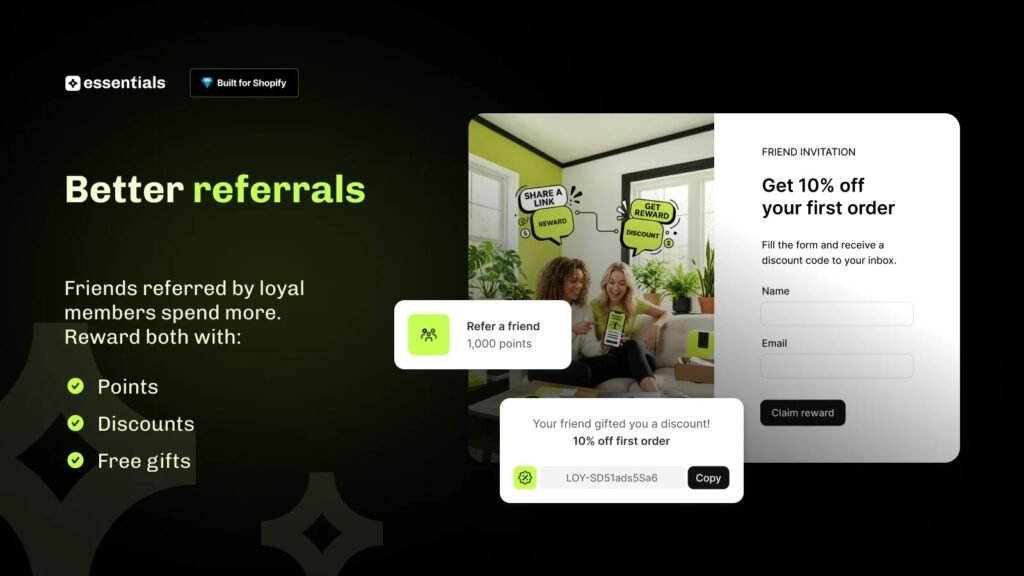
Essential Loyalty Program Rewards Makes This Simple
If you want all of this built in, Essential Loyalty Program Rewards does the heavy lifting. Set up your referral structure in minutes, the app handles tracking and payouts automatically, and you get real-time analytics without touching code.
It integrates directly with Shopify so referral credits sync with your store, supports multiple reward types, and makes the referral page customizable to match your brand. Most merchants see their first referral conversion within days of launch.
If referral revenue is on your roadmap, Essential Loyalty Program Rewards gets you there faster than building it yourself or wiring together multiple tools.
Frequently Asked Questions
What percentage of my customers will actually participate in a referral program?
Typically 5-10% of your customer base will actively refer if the reward is compelling. Your top 1-2% become prolific referrers. Participation depends heavily on incentive structure and how visible you make the program.
Can I run a referral program if my profit margins are thin?
Yes, but keep rewards at 5-8% of AOV instead of 10-15%. You can also use tiered rewards to keep costs controlled while still motivating referrals. Essential Loyalty Program Rewards lets you set custom reward amounts to fit any margin profile.
How long does it take to set up a Shopify referral program?
If you use the right tool, 30 minutes to an hour. You configure incentives, customize the referral page, add promotion links, and launch. Manual setups or custom builds take weeks.
What’s the best referral reward type for ecommerce?
Store credit and discount codes work best because they drive immediate second purchases. Points systems work well for loyalty-focused brands. Essential Loyalty Program Rewards supports all three so you can pick what fits your strategy.
Should I offer rewards to both the referrer and the new customer?
Two-way rewards (benefiting both parties) drive higher participation and faster program growth. If margins allow, go two-way. It typically costs 1.5-2x more than one-way programs but generates 3-4x more referrals.