For many Shopify brands, the appeal of gift-with-purchase is obvious. It can make an offer feel more valuable without relying on another percentage discount. But once the campaign goes live, many merchants realize that a free gift does not automatically translate into more profit.
If the threshold is too easy to reach, the gift is not compelling, or the technical setup feels clunky, customers may not respond the way you expected. Instead of lifting AOV, the campaign simply adds cost.
This guide explores six gift-with-purchase strategies that are more likely to drive meaningful results. We will also cover how to match each strategy to your goal, the mistakes that can hurt performance, and which Shopify apps to consider for running GWP campaigns smoothly. Let’s review them.
How to choose the right GWP strategy
Start with the business goal
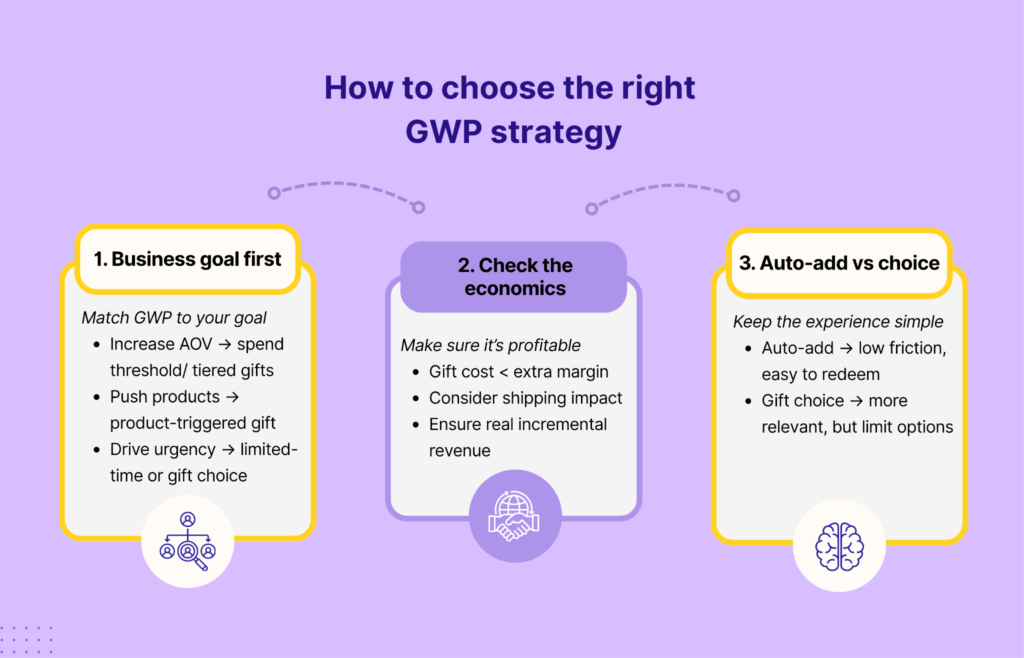
Use the campaign goal as your first filter. A simple way to match the format is:
- If the goal is to increase AOV, start with spend threshold gifts or tiered gift rewards because both give shoppers a clear reason to add more to the cart. These formats work best when the reward feels worth reaching for, and the threshold is set above your usual order value.
- If the goal is to push a specific SKU or collection, use a product-triggered gift. This approach works well when the gift complements the main item and makes the purchase feel more complete, such as a sample, an accessory, or an add-on product.
- If the goal is retention, seasonal buzz, or launch momentum, limited-time gifts and gift choice campaigns are often a better fit. They create a stronger reason to act now and can make the offer feel more relevant to different customer preferences.
Check the economics first
In most cases, the threshold should be high enough to drive extra spend, while the gift’s cost stays below the extra margin the offer is likely to generate.
Before launching, check these 3 numbers:
- Gift cost – direct cost of the item you are giving away, not its retail value. A gift may look attractive to shoppers, but if the real product cost is too high, the campaign can eat into profit very quickly.
- Shipping impact – a free gift can increase parcel weight, package size, or fulfillment complexity. That means an offer that looks profitable at the cart level may become less efficient once shipping and handling are included.
- Incremental revenue – the extra revenue generated when customers spend more to qualify for the gift. If the threshold is too low, many shoppers may have reached it anyway, which means the store gives away margin without gaining much additional value.
Decide between auto-add and customer choice
Auto-add usually works better when the offer is simple, and you want the lowest friction possible. If the customer qualifies and the gift automatically appears in the cart, the experience is easier to understand and redeem.
Gift choice is better when one free item may not appeal to every shopper. Letting customers choose can improve relevance, but the selection should stay focused so the offer still feels easy to claim rather than another decision to make.
Top 6 gift-with-purchase strategies that boost Shopify sales
Spend-threshold gifts
Spend threshold gifts are promotions where shoppers receive a free gift once their order reaches a specific value, such as “Spend $75, get a free travel pouch.” This strategy works because it gives customers a clear target and a simple reason to add one more item to the cart. It is also one of the easiest offers to communicate across the product page, cart drawer, and announcement bar, since the value exchange is immediately obvious.
Another advantage is that it can lift the AOV without training customers to wait for markdowns. Instead of discounting the main product, you preserve pricing while making the order feel more rewarding.
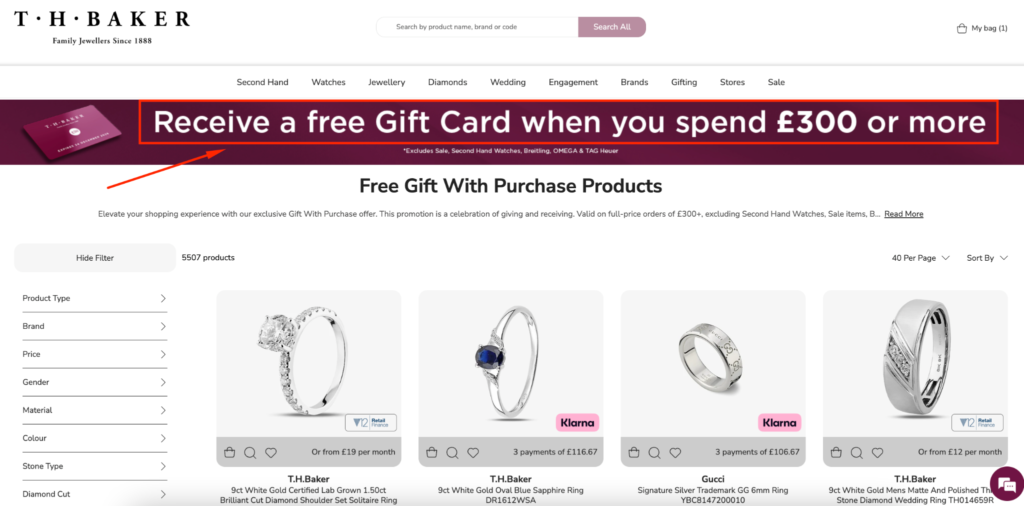
T.H.Baker is a strong example of this approach. The brand uses a prominent sitewide message that says shoppers receive a free gift card when they spend £300 or more, turning the spend threshold into a visible shopping goal.
From a margin perspective, the threshold should never be chosen at random. A practical starting point is to place it around 25% to 35% above your current AOV, so the target feels achievable while still creating real cart lift. The gift cost should remain comfortably below the extra profit generated by the additional spend required to unlock it.
Product-specific gifts
Product-specific gifts are tied to a particular item or collection rather than the whole store. This strategy is useful when you want to increase conversion on a hero product, support a high-priority category, or make the main purchase feel more complete.
Its biggest strength is relevance. When the gift naturally fits the product being purchased, the offer feels thoughtful and useful rather than generic. A serum paired with a cleanser sample, or a camera paired with a memory card, creates a stronger value perception because the gift enhances the core purchase rather than distracting from it.
NecessaryGood shows this clearly. The brand offers a free tote with skincare orders, meaning the gift supports a specific collection rather than every order on the site.
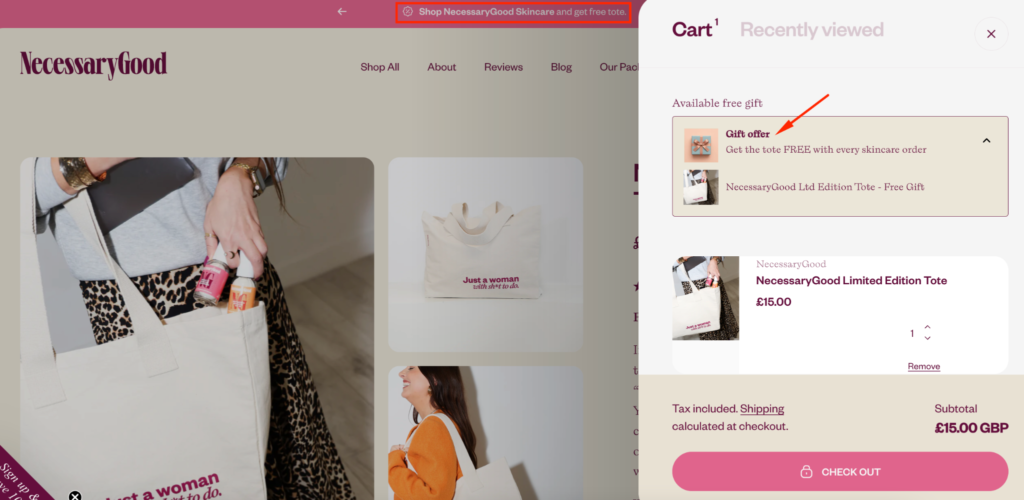
For margin, the safest gifts are usually samples, mini sizes, lightweight accessories, or branded extras with low cost and high perceived value. The goal is to make the main product more attractive without letting the gift absorb too much of the order’s profit.
Buy X Get Y as a gift
Buy X, Get Y as a gift is a promotion in which customers buy a required quantity or set of products and receive another item as a free gift. This is especially effective when the goal is to increase units per order, accelerate volume, or attach a complementary product to the main purchase.
What makes this strategy powerful is its clarity. Customers are not being asked to “spend more” in a vague way. They are being given a direct action, such as buying two items to unlock a gift, which often makes the decision easier and faster.
Odyssey Boards is a clear example. The store offers a free tote bag when shoppers buy 2 or more T-shirts, so the gift is used to increase the quantity of products in the same order.
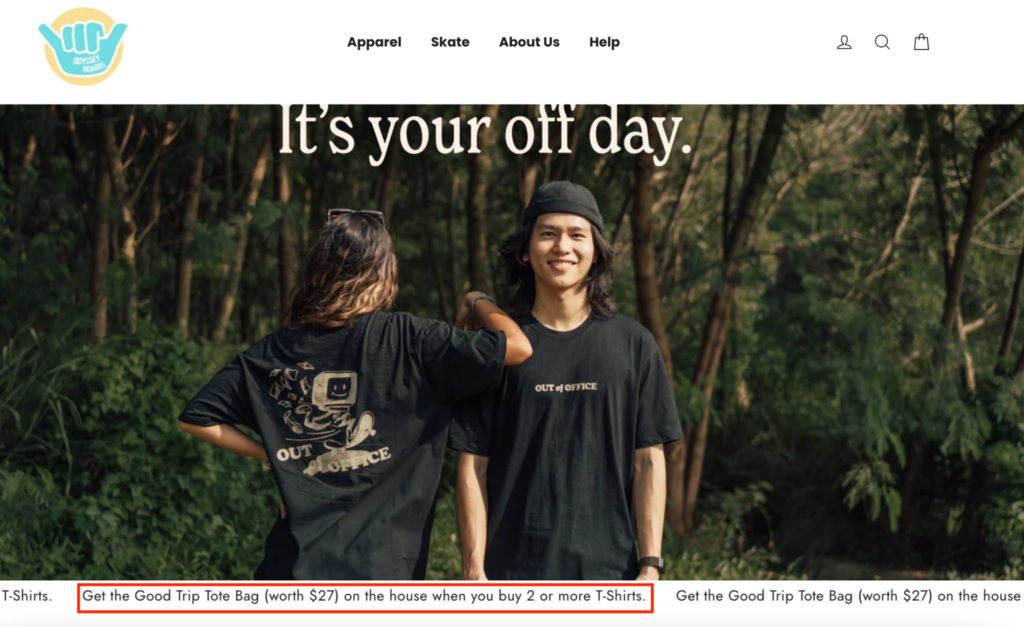
Margin control matters a lot here. If the qualifying product already has a tight margin and the gift is too expensive, the promotion can erode profitability very quickly. The best gifts are usually low-cost add-ons that fit the product naturally and do not make the main item feel overpriced.
Tiered gift rewards
Tiered gift rewards take the threshold model one step further by offering multiple reward levels rather than just one. A customer might receive gift A at $100, gift B at $150, and a premium gift choice at $200. This creates a “spend more, get more” journey that encourages shoppers to keep climbing rather than stopping at the first reward.
The main advantage is momentum. Once customers get close to one reward level, they often start looking at the next one too, especially if the gap between tiers feels reasonable and the reward upgrade is meaningful. That makes this strategy especially useful for stores trying to move customers through multiple cart value jumps in one session.
The Look & Co. is a strong visual example here. The store shows a reward progress bar with three milestones: Unlock Gift at $150, Unlock Gift Level 2 at $350, and All Gifts Unlocked at $500, making the reward path easy to understand at a glance.
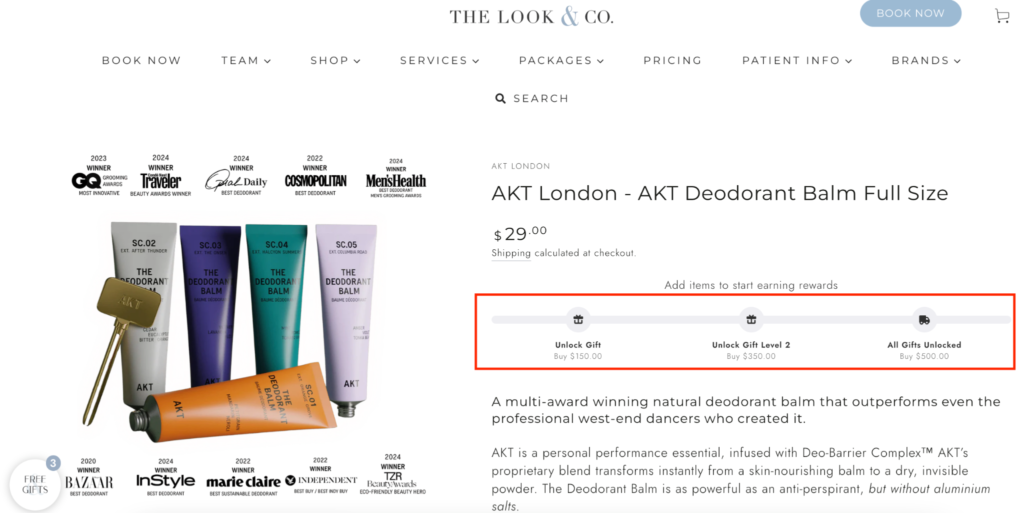
For margin, each tier has to feel genuinely better than the one before it. If the thresholds rise but the gifts remain unappealing, shoppers lose the incentive to keep adding products. Financially, the cost of each reward tier should grow more slowly than the incremental profit generated by the additional cart value required to reach it.
Limited-time or seasonal gifts
Limited-time or seasonal gifts are offers tied to a specific period, event, or campaign moment, such as Black Friday, Valentine’s Day, back-to-school, product launches, or end-of-season pushes. Their strength comes from urgency. Customers are not only attracted by the gift itself, but also by the feeling that the opportunity may disappear soon.
This makes the tactic especially useful when a store needs a short-term conversion lift without relying entirely on price cuts. A seasonal gift can make a campaign feel fresh, timely, and exclusive, even if the product lineup itself has not changed.
Innisfree is a good example. The store promotes a welcome gift and clearly states that the offer ends on March 31, 2026, at 11:59 PM ET, or while supplies last, combining a hard deadline with stock scarcity in a single message.
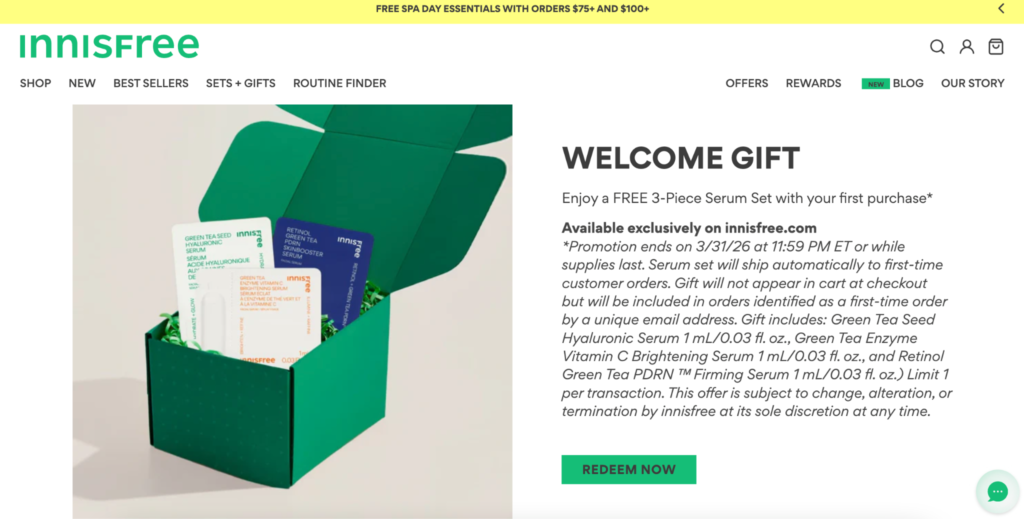
From a margin perspective, these offers work best when they are truly limited. If a “seasonal” gift lasts too long, it stops feeling special and can become an expected cost. The safer approach is to reserve stronger gifts for high-value campaign windows and cap inventory based on a defined promotional budget.
Gift choice promotions
Gift choice promotions let customers choose one gift from several options instead of receiving a fixed item. This is particularly effective for stores serving different customer types or multiple categories, because the same gift will not feel equally relevant to everyone.
The biggest benefit is perceived fit. When customers can choose the gift that suits them best, the reward feels more useful and personal, which usually improves satisfaction and reduces the chance that it feels like filler. At the same time, too many options can create decision friction, so the gift set should stay curated rather than open-ended.
Glossier is a strong example: in the cart drawer, the brand shows an “Add a free sample” module that lets shoppers choose their preferred samples instead of receiving a random one.
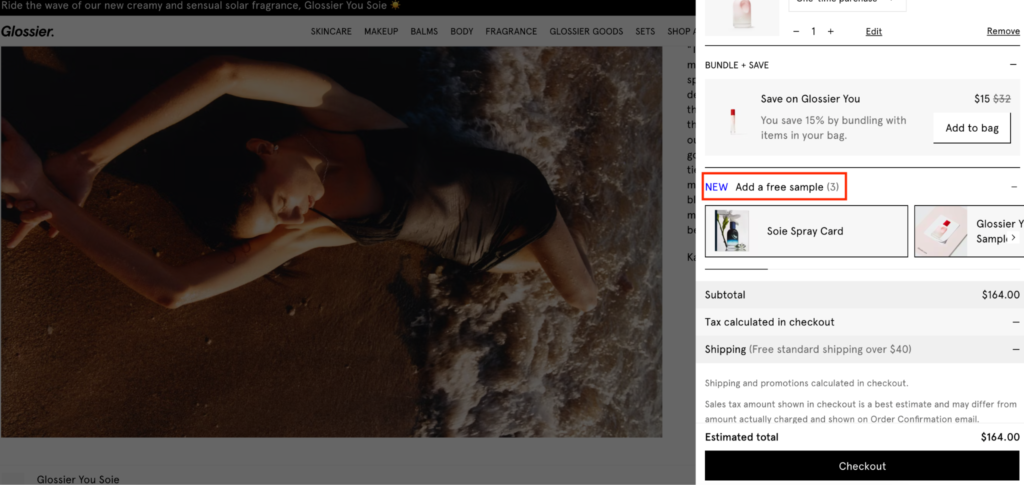
Margin planning matters here as well. The safest approach is to offer gift options with similar cost profiles, so customers do not all gravitate toward a single, expensive option that weakens the campaign’s economics. A small, well-balanced set of choices usually performs better than a large list that slows the checkout experience.
Top 3 Shopify apps to consider for gift-with-purchase campaigns
#1 BOGOS: Free Gift Bundle Upsell
Best for: Growing and established stores that need one app to run complex gift campaigns, bundles, and upsells together.
Pricing: Free plan available. Paid plans range from $29.99 to $109.99 per month, with included free orders based on plan.
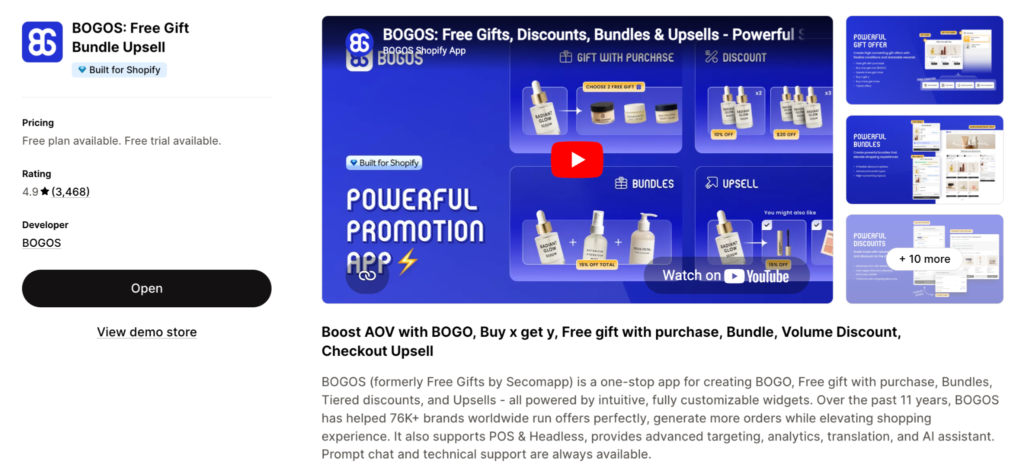
BOGOS is built for merchants who want more than a basic free gift rule. It supports free gift with purchase, BOGO, BXGY, product bundles, volume discounts, progress bars, and gift popups within a single system, making it a strong fit for stores running multiple promotions at once. If your store needs tiered rewards, gift selection, and cart-based upsells in the same campaign window, BOGOS is the most complete option of the three.
Key GWP Features:
- Create sophisticated free gift campaigns based on cart value, quantity, specific products, collections, customer tags, location, and purchase history.
- Support both auto-add gifts and customer-facing gift selection through customizable gift popups and sliders.
- Run advanced tiered free gift promotions (e.g., spend $50 get gift A, spend $100 get gift B) that escalate rewards as cart values increase.
- Launch BOGO and Buy X Get Y campaigns with flexible purchase criteria, including product combinations, cart quantity, and customer segments.
- Combine free gifts with discount codes for stacked promotional campaigns that maximize customer incentives.
- Set multiple purchase criteria simultaneously (e.g., buy from collection X + spend $75 + use code GIFT) for exclusive gift eligibility.
- Add progress bars, gift thumbnails, promotional banners, and dedicated offer pages to make reward thresholds clear and motivating.
Other Features:
- Product bundles (classic, mix & match, bundle builder pages)
- Strategic upsell placements across the customer journey
- Volume discounts and quantity break promotions
- Real-time analytics and performance tracking
| Pros | Cons |
| Handles complex tiered gift logic and multiple criteria with ease. Replaces multiple promotional apps with one comprehensive platform. Supports both auto-add and customer gift selection experiences. Advanced targeting enables highly personalized gift campaigns. Real-time inventory sync prevents gift overselling. | Pricing is higher compared to single-purpose GWP apps. Extensive features may require a learning curve for basic use cases. |
#2 EG Auto Add to Cart Free Gift
Best for: Stores that want a simple app focused on automatically adding the right gift to the cart.
Pricing: $14.99 to $29.99 per month, with a 5-day free trial.
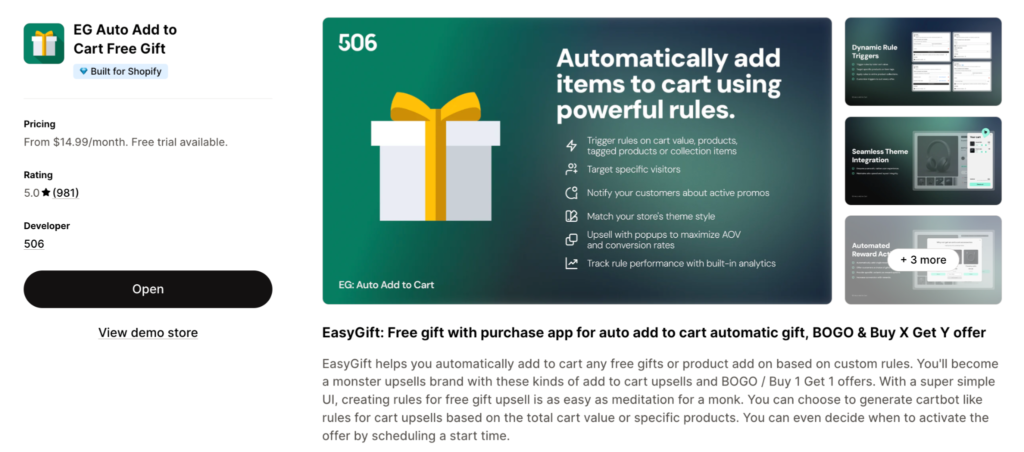
EG Auto Add to Cart Free Gift is much more focused than a broad promotion suite. Its strength is straightforward automation: when a shopper buys a specific product, shops a specific collection, or reaches a specific cart value, the app adds the gift based on the rule you set. This makes it a practical choice for merchants who care most about reliable auto add gifting and do not need deep bundle or merchandising features.
Key GWP features:
- Automatically add gifts when the cart reaches a certain value or contains certain products.
- Trigger free gift campaigns from specific products or collections.
- Schedule BOGO and Buy X Get Y offers to run during a defined campaign period.
- Set targeted rules for different gift scenarios rather than relying on a single storewide rule.
- Support add-to-cart upsells for gift-based promotions.
| Pros | Cons |
| Lower starting price than the other two apps. Focused, easy-to-understand feature set. A good fit for merchants who mainly want auto-add gifting. | Less suitable for tiered gift ladders and richer promo experiences. Not positioned as an all-in-one bundle and upsell platform. Advanced flexibility is stronger on the higher tier. |
#3 Kite Discount, Free Gift, BOGO
Best for: Stores that want free gifts, discount logic, and progress bars in one app built on Shopify Functions.
Pricing: Free to install for development and affiliate stores. Paid plans start at $19 and go up to $49 per month, with a custom discount builder add-on available.
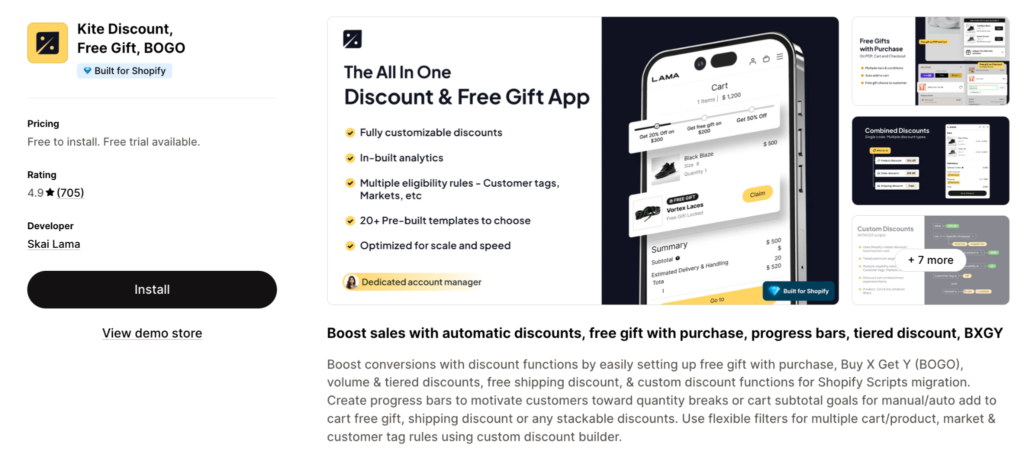
Kite Discount, Free Gift, BOGO sits between a simple gift tool and a full-scale promotion suite. It supports free gift with purchase, BOGO, tiered discounts, quantity discounts, free shipping bars, and combined discount logic, making it a strong option for stores that want more flexibility without moving to a heavier platform. For merchants who care about cart goals and discount functions, Kite offers a well-balanced feature set for the price.
Key GWP features:
- Offer both manual and auto add free gifts based on cart subtotal or product quantity.
- Run Buy X Get Y, BOGO, tiered discount, and volume discount campaigns from one app.
- Add goal-based progress bars and free shipping bars to encourage shoppers to reach reward thresholds.
- Combine discounts under a single manual or automatic discount code for larger campaigns.
- Use custom filters for cart rules, products, markets, and customer tags.
| Pros | Cons |
| Strong value for stores that want more than basic gifting. Built on Shopify Functions, which is a technical plus for modern stores. Includes progress bars and discount stacking support. | Not truly free for live stores beyond limited use cases. Less broad than BOGOS for bundles and upsell depth. May not be necessary for merchants who only need a single simple gift rule. |
Common GWP mistakes to avoid
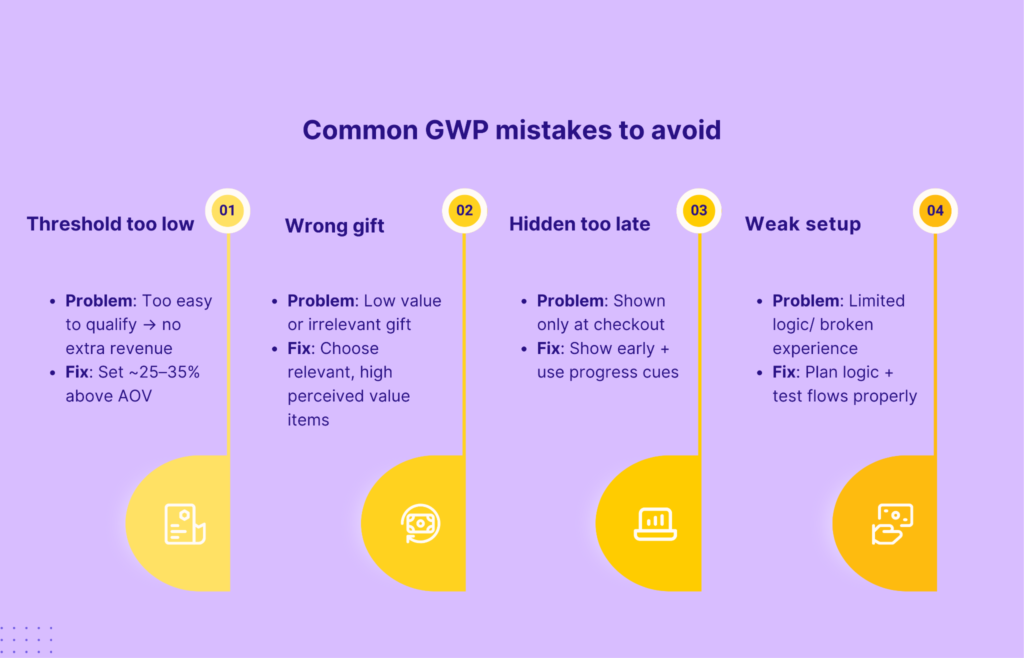
Setting the threshold too low
If the threshold sits too close to your current AOV, many shoppers will qualify without changing their basket in any meaningful way. That makes it much harder for the campaign to generate enough incremental revenue to offset the cost of the gift, shipping, and handling.
Solution:
- Set the threshold high enough to encourage one more meaningful product addition, rather than rewarding carts that would have converted anyway.
- A practical starting point is to test a threshold around 25% to 35% above your current AOV.
- Validate the math before launch so the extra spend covers the gift cost, shipping impact, and operational costs.
Giving away the wrong product
A gift only works if customers feel it is worth unlocking. If the reward feels random, low value, or disconnected from the main purchase, it will struggle to lift the cart and may even weaken a premium brand image. Product-specific gifts often perform better because they feel like a useful extension of the purchase instead of leftover inventory dressed up as a reward.
Solution:
- Choose a gift that is clearly related to the main product, the collection, or the customer’s shopping intent.
- Prioritize items with strong perceived value and low cost, such as samples, mini sizes, accessories, or branded add-ons.
- Avoid gifts that feel generic or off-brand, especially if your store competes on quality or premium positioning.
Hiding the offer until checkout
If shoppers only discover the promotion at the final step, the campaign loses much of its power, as they have no time or incentive to add more items to reach the threshold. GWP works better when the offer appears earlier in the journey and stays visible across key touchpoints such as the announcement bar, product page, cart drawer, and progress messaging.
Solution:
- Show the offer before checkout so customers know there is a reward worth aiming for.
- Reinforce it throughout the journey with clear threshold messages and cart reminders.
- Use progress bars or cart prompts to show how much more the shopper needs to spend to unlock the gift.
Ignoring the technical setup
Many merchants assume a basic native setup can handle every GWP campaign, but more advanced offers often need logic beyond simple discount rules. Auto-add gifts, tiered rewards, gift choice, combined criteria, and customer-specific targeting often require a more flexible setup to ensure a smooth, reliable experience. This becomes even more important when multiple promotions need to run at the same time without conflicting in the cart.
Solution:
- Map out the exact campaign logic before launch, including triggers, exclusions, reward behavior, and where the offer should appear in the customer journey.
- Use a setup that supports the experience you want, especially if you need auto-add, tiered rewards, progress bars, or selectable gifts.
- Test the promotion across the cart and checkout flows, and with overlapping discounts, to ensure the experience does not break when customers qualify in different ways.
Conclusion
So, where does that leave us? A gift with purchase is still one of the most effective ways to make an offer feel stronger without resorting to another discount, but it only pays off when the economics and the experience work together.
If you choose the right format, communicate it early, and support it with the right app or setup, GWP can help drive higher order values, better conversion, and more memorable campaigns. That is what makes it worth doing well.
FAQs
Can a free gift be more profitable than a discount?
Yes. A gift can feel much more valuable to the shopper than it costs the merchant, which is why it can protect margin better than an equivalent discount.
Can Shopify natively run a storewide “Spend $100, get a free gift” offer?
No. Native Shopify supports Buy X Get Y-style gift offers for specific products or collections, but not storewide cart-total thresholds like “spend $100 on anything.”
Can Shopify automatically add the free gift without an app?
No. Shopify’s native discount feature can apply the gift logic, but true auto add gifting typically requires a third-party app.
Should the GWP threshold be close to your current AOV?
No. A threshold that sits too close to the current AOV often rewards shoppers who would have qualified anyway, so many guides recommend starting around 25% to 35% above AOV.