Most Shopify merchants leave money on the table by not using loyalty points. Customers want rewards for repeat purchases, but many stores never set one up. If you’re not capturing that repeat revenue, your competitors probably are.
Loyalty points work by giving customers points for actions like purchases, referrals, or reviews. Those points accumulate and convert into discounts or free products. The result: customers come back more often, spend more per order, and stay with your brand longer.
After working with hundreds of Shopify stores wanting to build the best loyalty programs, we’re here to share our view and experience. Here’s how to set up a loyalty points system on Shopify and actually get customers to use it.
How Loyalty Points Work on Shopify
A loyalty points Shopify system tracks customer behavior and rewards them with points that have real monetary value. When a customer buys something, they earn points. When they’ve accumulated enough, they redeem those points for discounts or products.
The mechanics are simple but powerful. A customer spends $100, earns 100 points (or whatever ratio you set). They spend $500 total, earn 500 points, and redeem for a $25 discount. They feel rewarded. You get a repeat sale and higher lifetime value.
The key is making it obvious. Customers won’t come back for points they don’t see or understand. Your loyalty program needs to be visible at checkout, in their account, and in post-purchase emails.
Why Loyalty Points Increase Customer Lifetime Value
Loyalty points create a reason for customers to return. Without them, a customer buys once and leaves. With a points system, they’re motivated to come back specifically to use those accumulated rewards.
The math works. Customers with loyalty accounts spend 30-50% more over their lifetime than customers without them. They also refer friends more often because they get bonus points for referrals. That’s compounding revenue from a single customer base.
Points also reduce friction at checkout. Instead of thinking “this costs $100,” a returning customer thinks “this costs 100 points” or “I’ll get $50 off after this purchase.” The perceived price is lower, so conversion rates go up.
Core Features of a Shopify Loyalty Points Program
Point Earning Rules
You decide how customers earn points. The most common setup is 1 point per $1 spent, but you can adjust this to match your margins and AOV. Some merchants give bonus points on specific products to push inventory or drive traffic to certain categories.
You can also award points for non-purchase actions. Customers earn points for writing reviews, referring friends, or following your social media. These actions build engagement and word-of-mouth traffic, not just repeat purchases.
Point Redemption
Points convert to discount codes or free products at a rate you control. A common setup is 100 points equals $5 off. You can also let customers redeem points for specific products, exclusive items, or tiered discounts (e.g., 250 points = $15 off, 500 points = $40 off).
The redemption experience matters. Customers should be able to redeem in one click at checkout. If it takes three steps or multiple confirmations, redemption drops and your program looks broken.
Tier-Based Rewards
Advanced loyalty programs use tiers. Bronze members earn 1 point per $1. Silver members earn 1.5 points per $1. Platinum members earn 2 points per $1 and get exclusive perks. Tiers encourage spending because customers want to unlock the next level.
Tier progression is powerful psychology. A customer at 80% toward Silver status will make one more purchase to hit that threshold. You’ve just increased their AOV with minimal friction.

How to Set Up Loyalty Points on Shopify
Choose Your Earning Structure
Decide on a point exchange rate before you launch. Most stores start with 1 point = $0.01 USD, meaning 100 points equals $1 off. This is simple for customers to understand and easy for you to track.
You can also set different earning rates for different product types. Clearance items might earn 0.5 points per $1. Premium or full-price items might earn 1.5 points per $1. This steers customer behavior toward higher-margin sales.
Define Redemption Options
Decide what customers can redeem for. Most Shopify stores offer discount codes. Some offer free shipping, free products, or exclusive access to new collections. The more redemption options, the more engaged customers become.
Set a minimum points threshold for redemption. Don’t let customers redeem 10 points for a $0.10 discount. It creates clutter and makes your program look weak. A typical minimum is 100 points ($1 off) or higher.
Make It Visible Across Your Store
Your loyalty program needs presence at three critical touchpoints: product pages, checkout, and customer accounts. On product pages, show “Earn X points with this purchase.” At checkout, display the points they’re about to earn and remind them of points they already have. In customer accounts, show their current balance and available redemptions.
After purchase, send an email showing the points earned and their new balance. Include a direct link to shop again and earn more points. This keeps the program top-of-mind and drives repeat traffic.
Building a Loyalty Points Program That Actually Works
Make the Math Clear
Customers won’t engage with a program they don’t understand. If your earning rate is confusing, adoption drops. Make sure the point-to-dollar conversion is obvious and easy to calculate mentally.
Use language that connects points to real value. Instead of “You earned 250 points,” say “You’re $2.50 closer to a free item.” Dollar value is concrete. Points are abstract.
Offer Compelling Redemptions
A 1% discount feels weak. Customers see that and think the program isn’t worth their time. Offer redemptions that feel meaningful: 10-25% off based on points spent. Include exclusive products or experiences that non-members can’t access.
Limited-time redemptions create urgency. “Redeem your 500 points for 50% off this weekend only” drives immediate action. You increase redemption rates and repeat traffic in a single promotion.
Automate Communication
Send automated emails when customers earn points, get close to a redemption threshold, or have points expiring. These emails remind customers to come back and spend. They’re one of the highest-ROI touchpoints in your loyalty program.
Include a direct shopping link in every loyalty email. Make it easy for customers to browse and make another purchase without typing your store URL.
Common Loyalty Points Mistakes to Avoid
Don’t set up a complex earning structure. Three different point rates for three product categories is smart. Fifteen different rates confuses customers and kills engagement. Simplicity wins.
Don’t make redemption hard. If your loyalty program requires customers to copy a code or navigate through multiple screens, they’ll abandon it. One-click redemption is the minimum standard.
Don’t forget to promote the program at signup. Your loyalty program is worthless if customers don’t know it exists. Add signup incentives. Give new members 50 bonus points for joining. Display the program prominently on your homepage, in navigation, and at checkout.
Don’t set redemption thresholds too high. If customers need 1000 points to earn a $10 discount, the perceived value drops. Most stores see better engagement with 100-500 point redemptions.
Using Loyalty Points to Boost Repeat Purchases
Your loyalty program is a retention tool first, a discount second. The goal isn’t to give away margin. It’s to create a predictable reason for customers to come back.
Use your loyalty points data to identify your best customers. If you can see who’s closest to a redemption threshold, you can email them targeted product recommendations. “You have 380 points. One more purchase gets you to $5 off.” That’s a direct prompt to buy.
Test different earning rates and redemption levels. Start conservative (1 point per $1, 100 points = $1 off). Measure repeat purchase rate and customer lifetime value. If you see improvement, test a more generous structure (1.5 points per $1). Find the sweet spot where loyalty engagement increases without crushing margins.
Combine loyalty points with email segmentation. Segment customers by loyalty tier and send tier-specific offers. Platinum members get early access to new products. Bronze members get “spend $50 and earn double points” promotions. Tier-based marketing increases tier progression and repeat spend.
How Technology Makes Loyalty Points Easier
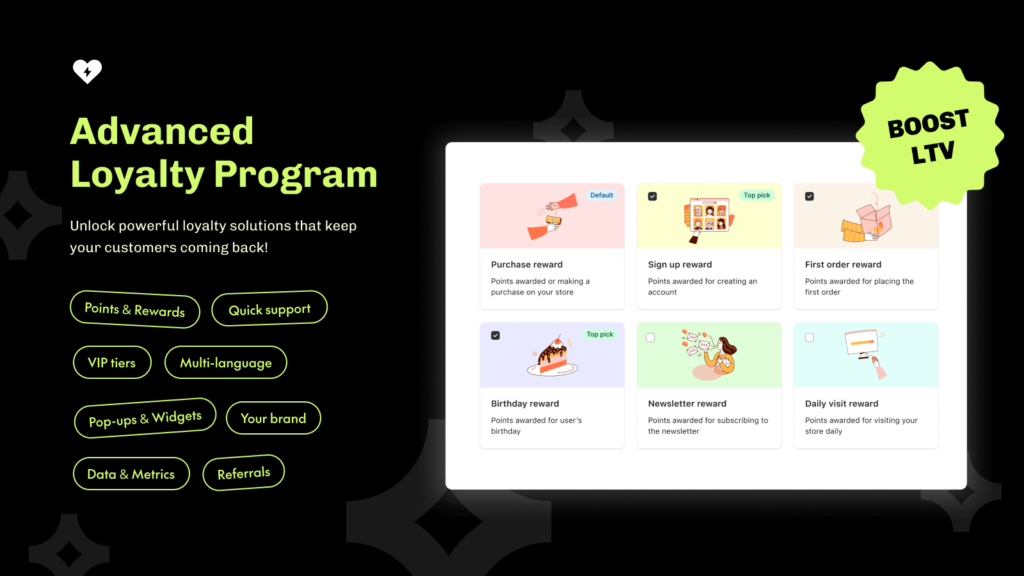
Manual loyalty tracking doesn’t scale. You need software that automatically tracks points, applies discounts, and sends emails. This is where an app like Essential Loyalty Program Rewards becomes essential. It handles all the backend complexity so you don’t have to.
A dedicated loyalty app for Shopify tracks every customer action, calculates points instantly, and makes redemption seamless at checkout. You set the earning rates and redemption tiers once, then the app handles everything else. You get real-time reporting on program performance, engagement rates, and revenue impact.
The app integrates directly with your Shopify store, so there’s no manual work. No exporting data. No manual point calculations. Everything syncs automatically with your customer accounts and checkout.
Essential Loyalty Program Rewards automates the entire loyalty workflow. Set up your earning rules and redemption tiers, then watch repeat purchases and customer lifetime value increase. The app tracks customer behavior, displays points at every touchpoint, and sends automated emails that drive repeat traffic.
Getting Started with Your Loyalty Program
Your first step is deciding on a clear earning rate and redemption structure. Choose values that feel generous to customers but protect your margins. Test your program with your most engaged customers first, then expand to all new signups.
Launch with a small incentive for joining. Give new members 50 bonus points just for signing up. This removes friction and gets your program data flowing immediately so you can measure impact.
Track three metrics from day one: signup rate (percentage of customers who join), engagement rate (percentage who earn points), and redemption rate (percentage who actually use points). If any of these is below 40%, your program needs adjusting.
After 30 days, compare repeat purchase rate and customer lifetime value for loyalty members vs. non-members. You should see clear separation. If you don’t, your earning rates or redemption options need adjustment.
Loyalty Points as a Competitive Advantage
Customers remember stores with loyalty programs. They shop there more often. They spend more per order. They refer friends. And they tolerate price increases better because they feel invested in the brand.
A well-built loyalty points program isn’t a cost center. It’s a revenue multiplier. You’re not giving away discounts. You’re buying customer retention at a rate that increases lifetime value faster than the discount costs you.
The stores winning in competitive categories right now aren’t competing on price. They’re competing on loyalty. They make repeat customers feel valued, and those customers come back automatically.
If you’re ready to implement loyalty points on your Shopify store, Essential Loyalty Program Rewards handles the entire setup and management. Our Shopify loyalty app automates point tracking, redemption, and customer communication so you can focus on growing sales from your existing customer base.
Frequently Asked Questions
How do Shopify loyalty points impact profit margins?
Loyalty points reduce immediate margin on each transaction, but increase total profit by driving repeat purchases and higher lifetime value. Most merchants see a 15-30% increase in customer lifetime value, which more than offsets the discount cost.
What’s the best exchange rate for loyalty points?
The most common rate is 1 point per $1 spent, with 100 points redeemable for $1 off. You can adjust based on your margins and AOV. Test and measure what drives engagement without eroding profit.
Can customers earn points for non-purchase actions on Shopify?
Yes. Many loyalty systems reward customers for referrals, reviews, social shares, and email signups. Essential Loyalty Program Rewards supports earning points from multiple actions, not just purchases, so you can build engagement across your entire marketing funnel.
How do you get customers to actually redeem loyalty points?
Make redemption obvious and easy. Show current point balance at checkout and in customer accounts. Send email reminders when customers are close to a redemption threshold. Use limited-time redemptions to create urgency.
Does Essential Loyalty Program Rewards integrate with existing Shopify stores?
Yes. Essential Loyalty Program Rewards integrates directly with Shopify and works with your existing store setup. You configure earning rules, redemption options, and customer communication in the app, and it handles all point tracking and redemption automatically at checkout.