You’re losing money every time a customer shops once and never comes back. The average Shopify store sees 98% of visitors leave without buying, and most first-time buyers never return. That’s a revenue leak you can actually fix with a loyalty rewards program.
A Shopify loyalty rewards program turns occasional shoppers into repeat customers by giving them reasons to come back. It’s not complicated. Points for purchases, discounts for loyalty, exclusive perks for your best customers. When done right, this generates more sales per customer without spending extra on ads.
After spending years building a simple no-code Shopify loyalty program app, we know merchants have many questions about Shopify loyalty rewards. You’ll find all the answers here.
What Are Shopify Loyalty Rewards?
Shopify loyalty rewards programs let customers earn points, badges, or discounts based on their actions. Customers shop, they earn. They accumulate enough points, they redeem a reward. It’s a structured incentive that increases repeat purchases and average order value.
The mechanism is simple. A customer buys $50 worth of products and earns 50 points (or whatever ratio you set). After 500 points, they unlock a $25 discount or free shipping. Some programs reward referrals, reviews, or social shares instead of just purchases. The structure depends on your business model and what drives your sales.
Why does this work? Customers feel valued; they have a reason to return, and the psychological effect of “almost earning” a reward is powerful. Someone with 480 points will come back to hit 500 and claim that discount. That’s repeat revenue you wouldn’t have gotten otherwise.
How Shopify Loyalty Rewards Drive Repeat Sales
Most loyalty programs fail because they’re built wrong. They either reward too easily (no real incentive) or too hard (customers give up). The ones that work follow a clear formula.
Increase Customer Lifetime Value
A customer who buys once might spend $50 total. A customer who comes back five times might spend $300. Loyalty rewards make that second scenario happen. You’re not creating new customers. You’re extracting more revenue from the ones you already have.
The math is simple. If your repeat customer rate goes from 20% to 30%, and repeat customers spend 2.5x more, you’ve increased revenue per cohort by roughly 37.5% with zero additional marketing spend. That’s why loyalty programs have ROI that rivals paid ads.
Reduce Churn
Customers with points sitting in their account feel ownership. They’re more likely to shop with you again before they redeem. Someone who’s earned 200 points toward a $30 discount is stuck between your store and a competitor. Loyalty rewards create that stickiness.
Boost Average Order Value
Many loyalty programs let customers earn faster for larger purchases or specific products. A customer might buy $40 worth of products, but when they see they need just $10 more to hit the next reward tier, they add something. That’s AOV growth that feels organic to the customer.
Generate Owned Customer Data
Every time someone signs up for your loyalty program, you capture their email, behavior, and preferences. This is data you own, unlike paid ads. You can segment customers by spend, reward status, or purchase history and send targeted offers that convert.
How to Set Up Shopify Loyalty Rewards
Setting up a loyalty rewards program doesn’t require coding. Apps like Essential Loyalty Program Rewards handle the infrastructure, tracking, and redemptions automatically.
Step 1: Choose Your Reward Structure
Decide what customers earn points for. Most programs use a 1:1 ratio (every $1 spent equals 1 point). Some use 0.5:1 or 2:1 depending on margin. Then set your redemption threshold. Typical programs let customers redeem at 100, 250, or 500 points.
What can they redeem for? Discount codes, free products, free shipping, or exclusive access. Keep options simple. More than three choices confuse customers and tank redemption rates.
Step 2: Install and Configure Your App
Once you pick a Shopify loyalty app like Essential Loyalty Program Rewards, installation takes minutes. This app integrates directly into Shopify and starts tracking customer purchases automatically. You’ll configure your earning rate, redemption values, and branding to match your store.
The setup is visual and intuitive. You’re not writing SQL queries or configuring webhooks. You’re clicking options and typing numbers. Most merchants go from install to live in under 30 minutes.
Step 3: Communicate the Program to Customers
The best program in the world fails if customers don’t know it exists. Add a banner to your homepage explaining how it works. Feature it in your email welcome series. Add a loyalty widget to your checkout so customers see their points after purchase.
Keep the message simple. “Earn 1 point per dollar. Reach 100 points for $10 off.” Complexity kills participation. Most successful programs have less than 10 words of explanation.
Step 4: Monitor Performance and Adjust
Track enrollment, redemption rate, and repeat purchase rate. If enrollment is high but redemption is low, your rewards aren’t valuable enough. If redemption is high but repeat purchases aren’t increasing, you’re not capturing the right behavior.
Most programs see best results after small tweaks. Maybe the threshold was too high, so you lower it by 20%. Maybe points expire after 12 months, so people feel urgency to spend. Essential Loyalty Program Rewards gives you detailed analytics so you can see exactly what’s working.
Common Mistakes to Avoid
Making Points Too Hard to Earn
If a customer has to spend $500 to earn a $20 discount, they’ll skip the program. A good rule of thumb: the reward should feel achievable in 3-5 purchases. That keeps motivation high.
Offering Rewards Nobody Wants
A 2% discount might seem fair to you, but if your margins are high, customers see it as cheap. Make sure your rewards actually feel valuable to your audience. Survey your customers or run a test with two different reward levels.
Not Promoting the Program
You can’t expect customers to find your loyalty program on their own. Add it to emails, your header, your checkout page, and your post-purchase follow-ups. Mention it in ads. The best loyalty programs are visible by default.
Ignoring Mobile Optimization
Most customers will check their points on their phone. If your loyalty widget doesn’t work on mobile or the UI is clunky, they’ll forget the program exists. Make sure your setup is mobile-first.
Real-World Results from Shopify Loyalty Programs
Merchants using loyalty rewards typically see a 15-30% increase in repeat purchase rate within the first 90 days. That means if 100 customers buy once, 15-30 more of them come back for a second purchase.
Average order value tends to increase 5-10% because customers are incentivized to reach the next tier. And because you’re building an email list of engaged, repeat customers, your retention metrics improve across all channels.
The exact numbers depend on your store, product, and pricing. A subscription box will see different results than a fashion brand. But the directional impact is consistent: loyalty programs increase revenue from existing traffic.
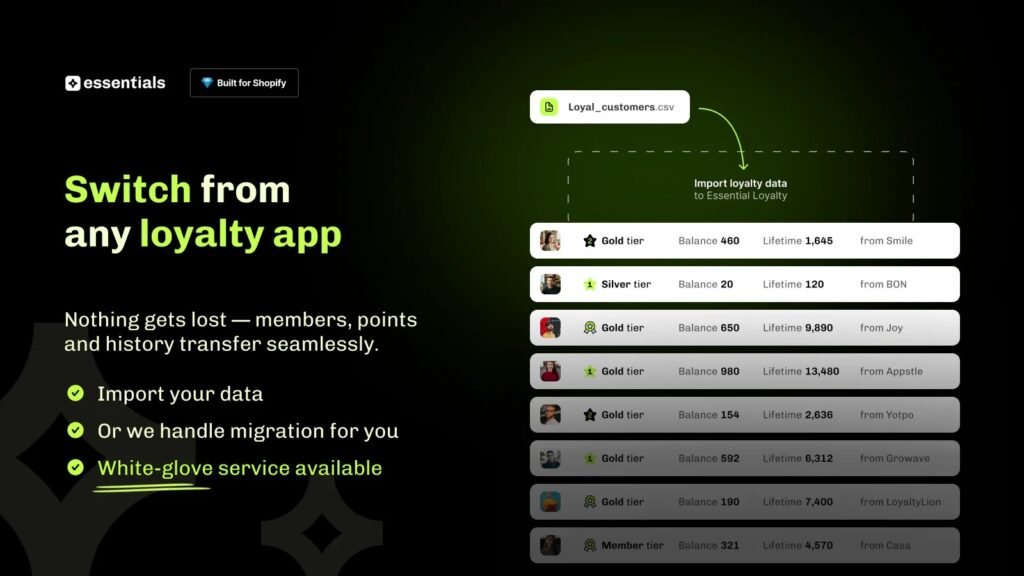
Getting Started With Essential Loyalty Program Rewards
If you’re running a Shopify store and haven’t launched a loyalty program yet, you’re leaving revenue on the table. Essential Loyalty Program Rewards handles the entire infrastructure for you. It integrates with Shopify in minutes, gives customers instant visibility into their points, and tracks redemptions automatically so you can see what’s actually driving repeat purchases.
Install it, configure your earning rate and rewards, promote it to your existing customers, and watch repeat purchase rates climb. For most merchants, the program pays for itself in 30 days through increased repeat sales alone.
Frequently Asked Questions
How much does a Shopify loyalty rewards program cost?
Essential Loyalty Program Rewards pricing is based on usage and features. Most Shopify stores start with a free or low-cost tier and upgrade as their program grows. The app typically pays for itself through increased repeat revenue.
Can I run a loyalty program without an app?
You can build a manual loyalty system using spreadsheets or email, but it’s error-prone and doesn’t scale. Essential Loyalty Program Rewards automates tracking, point calculation, and redemption so you don’t have to manage it manually.
What’s the best point redemption threshold?
Most successful programs use a threshold that’s achievable in 3-5 purchases. If your average order value is $50, a 100-point threshold (redeemable for $10 off) means customers earn a reward every 2-3 orders. Test your threshold and adjust based on redemption rate.
How do I increase loyalty program enrollment?
Promote your program at checkout, in your welcome email series, on your homepage, and in post-purchase follow-ups. Make enrollment a single click. The more visible it is, the higher your signup rate.
What happens if customers don’t redeem their points?
Most loyalty programs set an expiration date (12-24 months) to create urgency. You can also use this as an opportunity to re-engage inactive customers with an email reminder before their points expire.