Your customers are leaving money on the table every time they check out. They don’t know what pairs well with what they’re buying, and you’re not telling them. A frequently bought together strategy fixes this by showing customers relevant products at the exact moment they’re most likely to buy them.
When done right, frequently bought together recommendations boost your average order value (AOV) significantly. We’re talking 10-30% increases for most stores. The key is showing the right products, in the right place, at the right time.
Our team of experienced Shopify developers has seen many stores simply ignore this tactic entirely or implement it poorly with irrelevant recommendations. Here are our recommendations.
Why Frequently Bought Together Works
Customers expect to see product recommendations. They’re used to Amazon showing them what others bought with their item. But on Shopify, most stores show nothing, or show random products that have nothing to do with the customer’s cart.
When you show frequently bought together products, you’re doing two things at once. First, you’re providing a service, helping customers discover complementary items they actually need. Second, you’re capturing sales that would have walked out the door as single-item purchases.
The conversion lift comes from reduced friction. A customer viewing a coffee maker already wants coffee-related items. You’re not pushing an unrelated product. You’re answering an implicit need. They see a grinder or filters in your recommendation, and they add it without thinking twice.
Where to Place Frequently Bought Together Recommendations on Shopify
Placement matters more than most merchants realize. A recommendation in the wrong spot gets ignored. In the right spot, it converts like crazy.
Product Page Recommendations
The product page is your first opportunity. When a customer is viewing a single item, they’re already interested. Show them what people typically buy alongside that product. A customer looking at a phone case should see screen protectors right there on the page.
Product page recommendations typically lift AOV by 5-15% because the customer is engaged and hasn’t decided to leave yet.
Cart Page Recommendations
The cart page is your last chance before checkout. This is where frequently bought together really shines. Your customer has committed to buying something. Now you’re showing them what completes their purchase.
Cart page recommendations convert at higher rates than product page recommendations because the customer has already decided to buy. You’re just adding to their existing order.
Post-Purchase Recommendations
Some merchants also show frequently bought together on the order confirmation. This doesn’t increase the current order, but it drives repeat purchases. A customer who just bought a supplement might buy the complementary product the next week.
How to Set Up Frequently Bought Together on Shopify
You have two main approaches: manual curation or automated recommendations.
Manual Frequently Bought Together Setup
If you have a smaller catalog, you can manually decide which products go together. You’ll go through each product and manually select 3-5 complementary items. This takes time, but it gives you complete control over what shows up.
The downside is obvious: it doesn’t scale. If you add new products, you have to manually set up bundles for each one. And you’re guessing at what sells together instead of using actual sales data.
Automated Frequently Bought Together Based on Sales Data
The smarter approach is using software that analyzes your actual purchase history. By looking at your order data, the system identifies which products are genuinely bought together. If 40% of customers who buy a phone case also buy a screen protector, that’s a signal. The system learns over time and adjusts recommendations automatically.
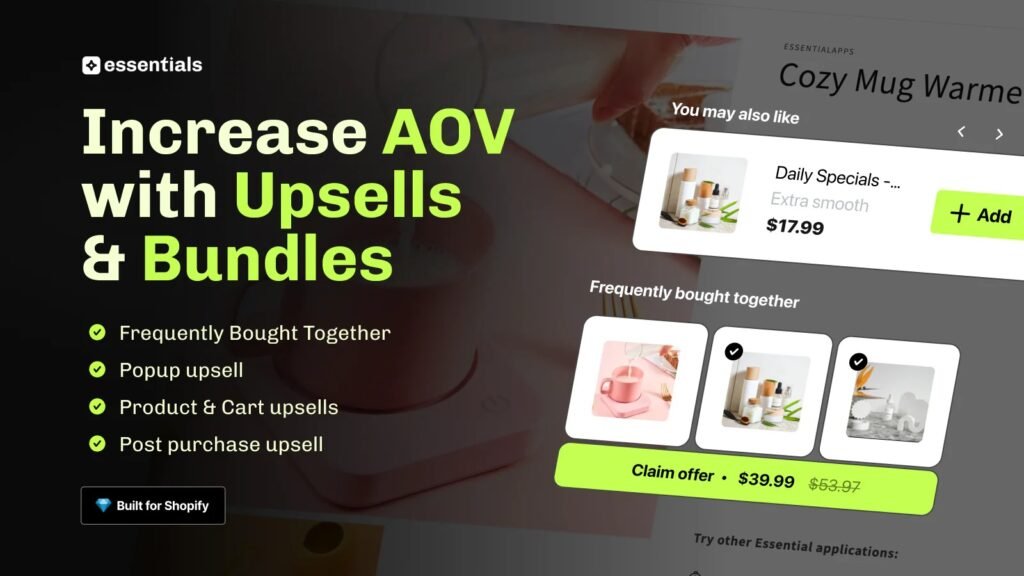
Tools like Essential Upsell & Cross Sell handle this automatically. The app analyzes your store’s purchase patterns and surfaces real frequently bought together recommendations on your product and cart pages. You’re not guessing; you’re showing customers what your actual customers have proven they want to buy together.
Setting Up Product Bundles vs. Frequently Bought Together
Don’t confuse these two. A product bundle is a fixed offer where you combine items and offer a discount (often requiring the customer to buy all items together at a set price). Frequently bought together is a recommendation that lets customers add individual items to their cart or not.
Frequently bought together is more flexible and converts better for most stores because customers maintain choice. They can add the recommended product or ignore it.
Best Practices for Frequently Bought Together on Shopify
Show Complementary Products, Not Competitors
Never recommend a competitor product next to your item. If you sell running shoes, don’t show other running shoes from your store. Show insoles, socks, or shoe care products. The frequently bought together strategy works because the recommended items complete the purchase, not replace it.
Limit to 3-5 Recommendations
More recommendations don’t mean more sales. In fact, they often reduce conversions because you’re overwhelming the customer with choice. Show your top 3-5 frequently bought together products and call it done. Quality over quantity.
Use Clear Labeling
Label the section something customers understand instantly. “Frequently Bought Together” works. “Customers Also Purchased” works. Avoid vague labels that make customers confused about why they’re seeing these products.
Test on Mobile
Most Shopify stores see 50-70% of traffic from mobile. Your frequently bought together recommendations need to look good and convert on small screens. Test that the recommendations don’t clutter the mobile experience.
Update Recommendations Regularly
If you’re manually curating, update your frequently bought together recommendations quarterly. Customer preferences change, new products launch, old products go out of stock. Don’t let your recommendations go stale.
Expected AOV Lift from Frequently Bought Together
Most Shopify stores see a 10-30% increase in AOV when they implement frequently bought together properly. Some high-performing stores see higher lifts, but 10-30% is the realistic range.
The exact number depends on your product category and how relevant your recommendations are. A store selling coffee equipment will see bigger lifts from frequently bought together than a store selling fashion basics, because the complementary products are more obvious and essential.
The most important factor is accuracy. If your recommendations are wrong or irrelevant, customers ignore them and your AOV doesn’t budge. This is why data-driven recommendations beat manual curation for most stores.
Frequently Bought Together vs. Other AOV Strategies
Frequently bought together is one of several strategies to increase AOV. You should also consider volume discounts, cart-level discounts, and product recommendations based on browsing behavior.
But frequently bought together is uniquely powerful because it addresses a specific customer need at a specific moment. A customer viewing a phone case doesn’t need a discount; they need to know what accessories go with it. Showing them those accessories is a no-brainer conversion play.
Common Mistakes to Avoid
The most common mistake is showing irrelevant products. A customer buying a t-shirt doesn’t automatically want to buy socks. The frequently bought together strategy only works if the recommendations actually make sense together.
Another mistake is placing recommendations too far down the page. If the recommendation is below the fold on mobile, most customers won’t see it. Place frequently bought together on your cart page where customers can’t miss it, and on product pages above the fold.
A third mistake is not testing. Every store is different. What works for a beauty brand won’t work exactly the same for an electronics store. Test your recommendations, measure the impact on AOV, and adjust.
Getting Started with Frequently Bought Together
Start simple. Pick your top 5 best-selling products and manually identify what customers typically buy with them. Review your last 100 orders and note which products appear together. That’s your baseline data.
Add those manually curated frequently bought together recommendations to your cart page first. That’s where they’ll have the most impact. Once you see the AOV lift, expand to other pages and products.
As you scale, automate the process. Essential Upsell & Cross Sell learns from your actual purchase data and handles the recommendations without manual work. Set it, and it keeps optimizing.
Start tracking AOV before and after you implement frequently bought together. You should see measurable lift within the first month if the recommendations are solid. If you don’t see improvement, your recommendations might be off. Go back and audit which products are actually being purchased together.
Why You Need an App for This
You could hardcode Shopify frequently bought together recommendations directly into your theme. But that requires coding work to add to your cart page, product page, and anywhere else you want recommendations. It also doesn’t automatically update based on your sales data.
Essential Upsell & Cross Sell handles both product page and cart page recommendations automatically. You don’t need to edit any code. The app analyzes your store’s purchase history and surfaces real frequently bought together recommendations. You control which products show up where, and the app handles the placement and display.
Frequently Asked Questions
How do you set up frequently bought together on Shopify?
You can manually pair complementary products in your theme code, but it’s easier to use a frequently bought together Shopify app like Essential Upsell & Cross Sell, which automatically identifies frequently bought together products from your sales data and displays them on product and cart pages without coding.
Does frequently bought together increase AOV?
Yes, most stores see a 10-30% AOV increase when they implement frequently bought together recommendations correctly. The key is showing truly complementary products at checkout or on product pages where customers are most likely to buy.
What’s the difference between frequently bought together and a product bundle?
Frequently bought together shows individual product recommendations that customers can add or skip. A bundle combines items and requires the customer to buy them together at a fixed price. Frequently bought together converts better because it maintains customer choice.
Should I manually pick frequently bought together products or use automation?
Automated recommendations based on your actual sales data outperform manual curation for most stores. Apps like Essential Upsell & Cross Sell analyze which products customers genuinely buy together, so your recommendations are based on real behavior, not guesses.
Where should I place frequently bought together recommendations?
Cart pages convert best because customers have already committed to buying. Place frequently bought together there first. Then add it to product pages above the fold. Avoid burying it below the fold on mobile, where most customers won’t see it.